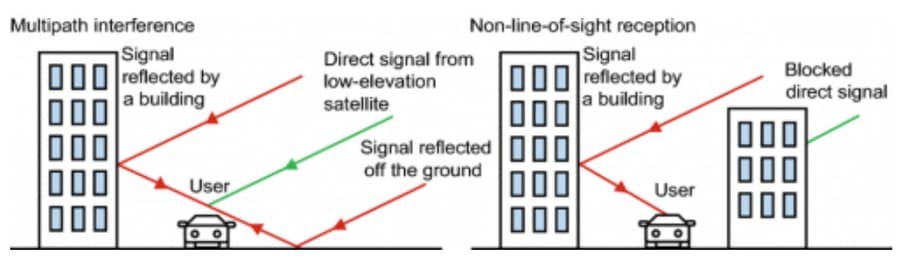
The challenge of Non-Line-of-Sight (NLOS) errors in Global Navigation Satellite Systems (GNSS) has been a significant hurdle in achieving precise urban navigation, affecting technologies like autonomous vehicles and smart city infrastructure. A recent study published in Satellite Navigation introduces an innovative Artificial Intelligence (AI) solution that leverages the Light Gradient Boosting Machine (LightGBM) to analyze multiple GNSS signal features, achieving a 92% accuracy in distinguishing between Line-of-Sight (LOS) and NLOS signals. This breakthrough, developed by researchers from Wuhan University, Southeast University, and Baidu, marks a pivotal advancement in urban navigation technology.
Urban environments, with their tall buildings and dense structures, often cause GNSS signals to be obstructed or reflected, leading to NLOS errors that degrade positioning accuracy. The new method utilizes a fisheye camera to label GNSS signals based on satellite visibility and analyzes features such as signal-to-noise ratio and elevation angle. By excluding NLOS signals from GNSS solutions, the research demonstrates substantial improvements in positioning accuracy, particularly in urban canyons where signal obstructions are prevalent.
Dr. Xiaohong Zhang, the lead researcher, highlights the method's potential to revolutionize urban navigation by enhancing the reliability of satellite-based systems. This advancement is crucial for the development of autonomous driving technologies and the broader implementation of smart city initiatives. The study's findings are supported by funding from the National Science Fund for Distinguished Young Scholars of China and the National Natural Science Foundation of China, among others, underscoring the collaborative effort between academia and industry in addressing this critical challenge.
The implications of this research extend beyond navigation, offering benefits to drones, urban planning, and other sectors reliant on precise GNSS data. As cities continue to evolve into smarter, more connected environments, the ability to accurately navigate urban landscapes becomes increasingly important. This AI-powered approach to identifying and mitigating NLOS errors represents a significant step forward in meeting this demand, promising to enhance the safety and efficiency of urban transportation systems and support the next generation of autonomous technologies.