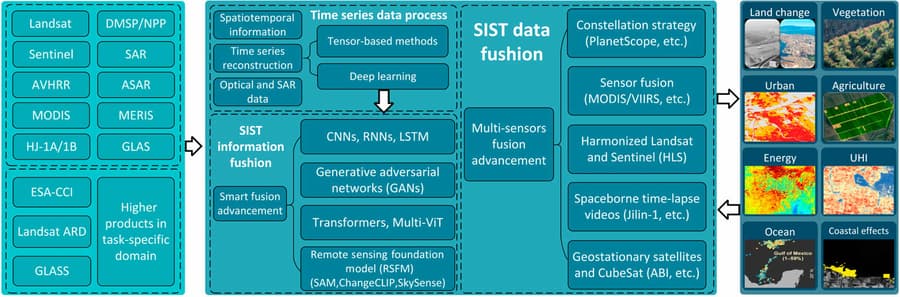
A recent study published in the Journal of Remote Sensing introduces a groundbreaking methodology for remote sensing time series analysis, combining deep learning algorithms with conventional techniques to significantly enhance the monitoring of environmental changes. This innovative approach, developed by an international team of researchers, leverages Long Short-Term Memory (LSTM) networks and Generative Adversarial Networks (GANs) to improve the accuracy and reliability of terrestrial monitoring data.
The integration of LSTM networks and GANs addresses common challenges in remote sensing, such as data gaps and atmospheric distortions, by capturing temporal trends and generating synthetic data to fill in missing information. This dual methodology has been validated against independent ground measurements, showing notable improvements in vegetation indices like the Normalized Difference Vegetation Index (NDVI). Such advancements are crucial for applications in agricultural surveillance, urban planning, and environmental management, where precise and timely data is essential.
The implications of this research are vast, offering a new tool for policymakers and scientists to better understand and respond to environmental dynamics. With the support of the National Nature Science Foundation of China, this technology is poised to play a key role in addressing global challenges such as climate change and sustainable development. The study, available for further review with the DOI:10.34133/remotesensing.0285, represents a significant leap forward in remote sensing technology, promising to revolutionize how we monitor and protect our planet's ecosystems.