

The Duquesne Family Office LLC, the investment firm of Stanley F. Druckenmiller, has joined Q.ANT's Series A funding round, bringing the German photonic computing company's total funding to $80 million—the largest financing round for photonic computing in Europe. This investment will accelerate commercialization of Q.ANT's light-based processors, drive next-stage technology development, and support expansion into the U.S. market. The global race to expand AI infrastructure has made semiconductor chips both strategic assets and geopolitical levers, with worldwide spending on AI-related data center infrastructure projected to exceed $5.2 trillion over the next five years according to a McKinsey forecast cited in The Economist.
However, this explosive growth faces a fundamental constraint: energy consumption. As data centers consume increasing shares of national power grids, efficiency has become the defining limitation on AI progress. Q.ANT addresses this challenge by computing natively with light, delivering the precision and performance that AI and high-performance computing demand while using only a fraction of the energy required by electronic chips. "AI is pushing the limits of global resources - energy, hardware, and capital," said Dr. Michael Förtsch, founder and CEO of Q.ANT. "At Q.ANT, we achieve performance through efficiency, not brute power alone, redefining how AI can scale."
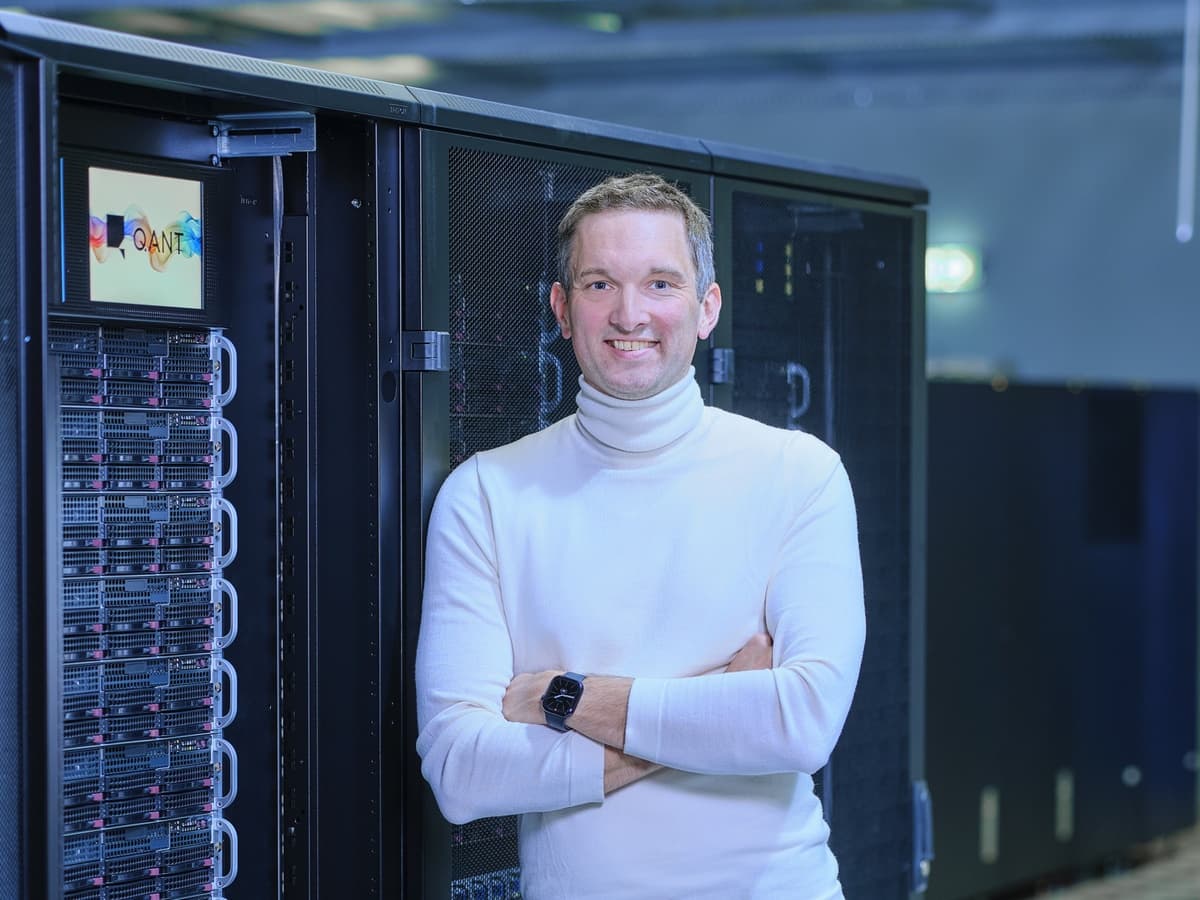
In just five years, Q.ANT has developed the world's first commercial photonic processor for real-world AI and HPC workloads. Built on Thin-Film Lithium Niobate material, the Q.ANT Native Processing Server integrates seamlessly into existing data centers as a plug-in co-processor. Early benchmarks show up to 30x greater energy efficiency, 50x performance gains, and the potential to increase data center capacity by 100x—all without active cooling requirements. The company achieves 16-bit floating-point accuracy equivalent to modern digital processors while retaining the continuous advantages of analog computing.
Industry analyst firm Gartner emphasizes the importance of this technology in its Emerging Tech: Emergence Cycle for Generative AI report, stating that "photonic computing has several potential benefits over electronic computing, including increased bandwidth, processing power and storage, all while keeping energy and power consumption under control." Q.ANT's photonic processors are now being evaluated by leading supercomputing data centers. Fully compatible with today's programming languages and AI software frameworks, the technology delivers higher compute density, eliminates on-chip heat, and consumes far less energy—positioning photonic processing as a potential foundational pillar of sustainable, high-performance computing by 2030.

