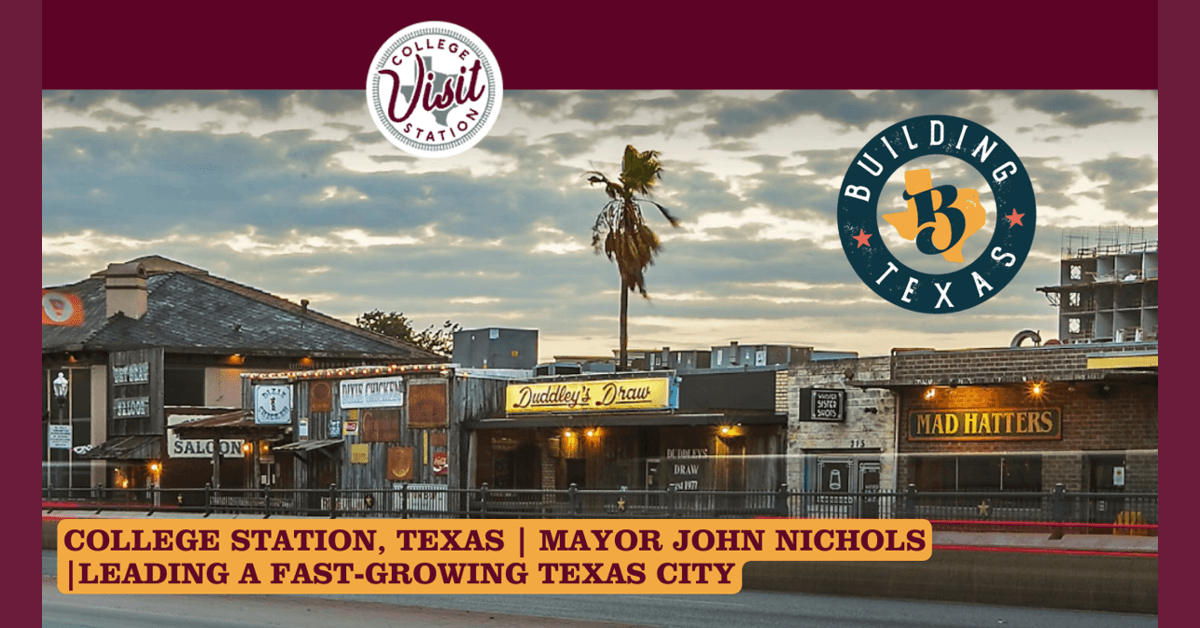
College Station is undergoing a fundamental economic transformation as it shifts from primarily serving as a university community to becoming a net private-sector employment city for the first time in its history. Mayor John Nichols detailed this evolution during a recent interview, explaining how the city's strategic planning is managing growth of approximately 2,000 residents annually while balancing the needs of permanent residents with its transient student population of nearly 80,000 at Texas A&M University.
The city's economic development strategy intentionally diversifies beyond education through entrepreneurship and innovation initiatives. College Station is exploring adaptive reuse of existing facilities to create flexible startup and innovation hubs in collaboration with Texas A&M programs and external partners. These efforts aim to lower barriers for early-stage founders who require space, connectivity, and support to grow their ventures, though access to capital remains a challenge as venture and growth funding remains concentrated in larger Texas metropolitan areas.
Regional collaboration that elevates the Brazos Valley's profile forms a central component of the city's long-term strategy to address capital limitations. Tourism complements College Station's economic engine through multiple channels, including weekends that draw over 100,000 visitors to Kyle Field, sports tourism, midweek conferences, and cultural programming anchored by the George H.W. Bush Presidential Library. The city leverages hotel occupancy tax revenue to reinvest directly into marketing, infrastructure, and visitor services through initiatives detailed on https://www.visitaggieland.com.
Looking ahead, Mayor Nichols identifies vertical development, infill projects, and infrastructure planning as defining themes for the next decade. With limited annexation opportunities, College Station's future will be shaped by density, transportation investment, and continued excellence in core services ranging from public safety to utilities. The city's growth narrative emphasizes stewardship alongside scale as Texas A&M expands its research footprint and attracts global talent.
College Station positions itself as a community where innovation, quality of life, and long-term planning advance simultaneously. The full interview providing additional insights into these developments is available through https://www.youtube.com/@TheBuildingTexasShow. This strategic approach to managed growth demonstrates how university cities can evolve beyond their educational foundations to create diversified, sustainable economies that serve both permanent residents and transient populations.