

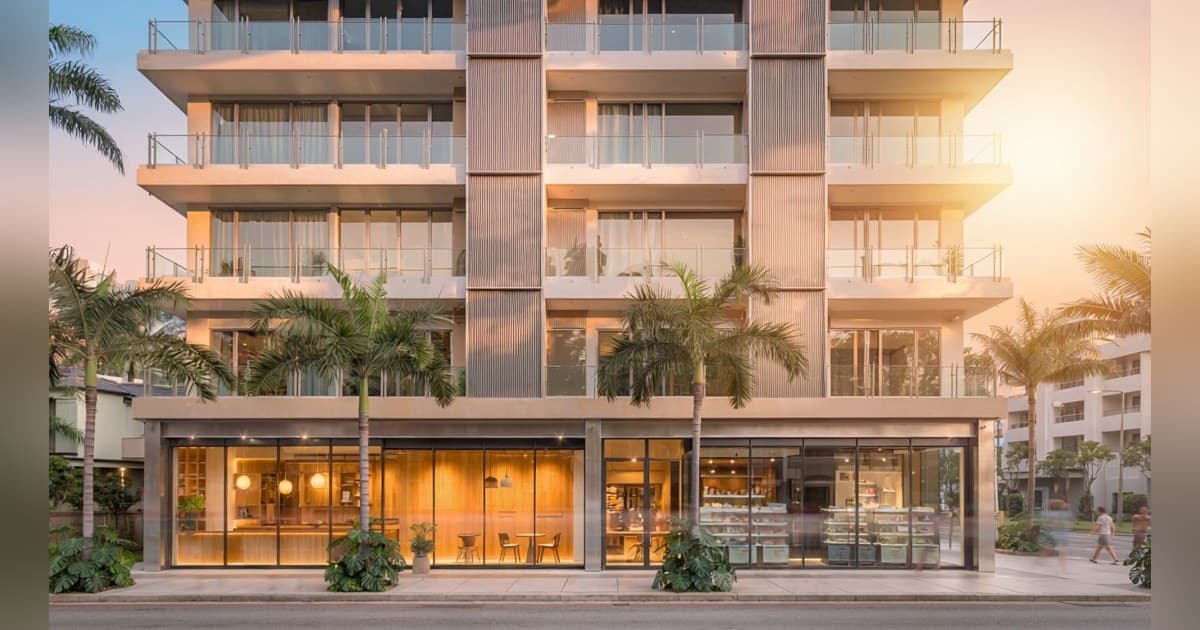
In urban Honolulu, the ground floor of a mixed-use apartment building is often undervalued, according to industry experts. While such properties are typically purchased as apartment buildings with retail space treated as a supplementary line, the commercial component at street level actually carries more weight than many buyers assume. This has significant implications for property valuation, underwriting practices, and investment strategies in the Hawaii real estate market.
The direct contribution of ground-floor retail is substantial. Retail rents in well-positioned buildings exceed residential rents on the same footprint, meaning the commercial space generates a disproportionate share of net operating income relative to its area. However, this advantage is location-dependent and not automatic. Where the position supports it, the arithmetic is straightforward, making a strong case for analyzing the commercial space separately rather than lumping it into a summary line.
The indirect contribution is harder to model but frequently larger. "It enhances the overall value of the actual property," says Erin W.J. Mitsuyoshi, CCIM, of The Bratton Team at Colliers International Hawaii. Well-chosen ground-floor tenants, such as a grocery store or café, function as building amenities that compete for residential tenants in the same way a gym or roof deck does—but without the operating cost. Appearance also matters: a well-maintained, visually active street frontage shapes how the whole building reads to prospective residents. At sufficient scale, ground-floor retail can shape neighborhood character, which in turn determines who wants to live there. Ward Village, the 60-acre master-planned community in urban Honolulu, exemplifies this, with a deliberately assembled street-level offer that creates a district identity attracting a particular kind of resident.
Tenant selection is critical. The most successful ground-floor tenants under apartments in Honolulu are those residents use regularly by habit rather than occasion. Daily-needs retail anchors the list—grocery or convenience stores, cafés, laundromats. Services also perform strongly, and Mitsuyoshi points to two often overlooked categories: medical services and childcare. A daycare downstairs is used five days a week by families above, a frequency almost no retail format matches. The composition varies by neighborhood, often along cultural lines, but the underlying principle is convenience—the strongest tenants are those where, as Mitsuyoshi puts it, everybody knows your name.
Underwriting mixed-use properties requires separating the residential and commercial components. Unlike standalone retail, which is analyzed as a single investment, mixed-use buildings must be bifurcated: each component modeled on its own terms before combining. Expense allocation is where the work concentrates. Most commercial space in Hawaii is leased on a triple net basis, so property taxes, utilities, and building expenses pass through cleanly on the retail side. The residential component does not carry those expenses on the same basis, and the two are not equally assessed. Allocating the right percentage to each requires deliberate work rather than a pro-rata split by square footage. Buyers who skip this step tend to misstate both components; those who do it properly often find the commercial income is more durable than they assumed.
Because the ground floor affects the residential component, tenant selection carries consequences beyond the lease. Compatibility of hours is a clear example: a late-night use below apartments creates friction with residents, as does any operator generating noise when residents are home. Proximity to a rail line or major road compounds the same question. These effects compound quietly—a use that unsettles residents can slow residential leasing, and an operator that struggles can bring arrears, additional security costs, or parking pressure that spills into residents' stalls. None of it appears in a rent roll, but all of it appears in the operating statement eventually. Mitsuyoshi frames these as ripple effects most people never see unless they sit on the ownership or property management side, which is precisely why they belong in acquisition diligence.
The ground floor's income depends on use and count. With one or two units and convenience retail, residents filter through constantly for small daily purchases. A café draws perhaps once or twice a week; a laundromat, weekly; childcare, five days. A building with several ground-floor units cannot rely on its own residents alone and needs to draw from the surrounding neighborhood. That is a solvable design question but changes which tenants make sense—and it is the kind of judgment that separates a ground floor which performs from one that merely fills. For owners, the useful conclusion is that the street level rewards being underwritten properly. Recent closed Hawaii transactions suggest buyers are increasingly pricing it that way.
Assets of this type appear regularly across current Hawaii commercial real estate inventory. The Bratton Team is a Hawaii commercial real estate and investment sales group, exclusively contracted to Colliers International HI, LLC. Led by Mark D. Bratton (R) CCIM and Mike Perkins (S), the team has advised buyers and sellers across all Hawaii asset classes for 40 years.
