

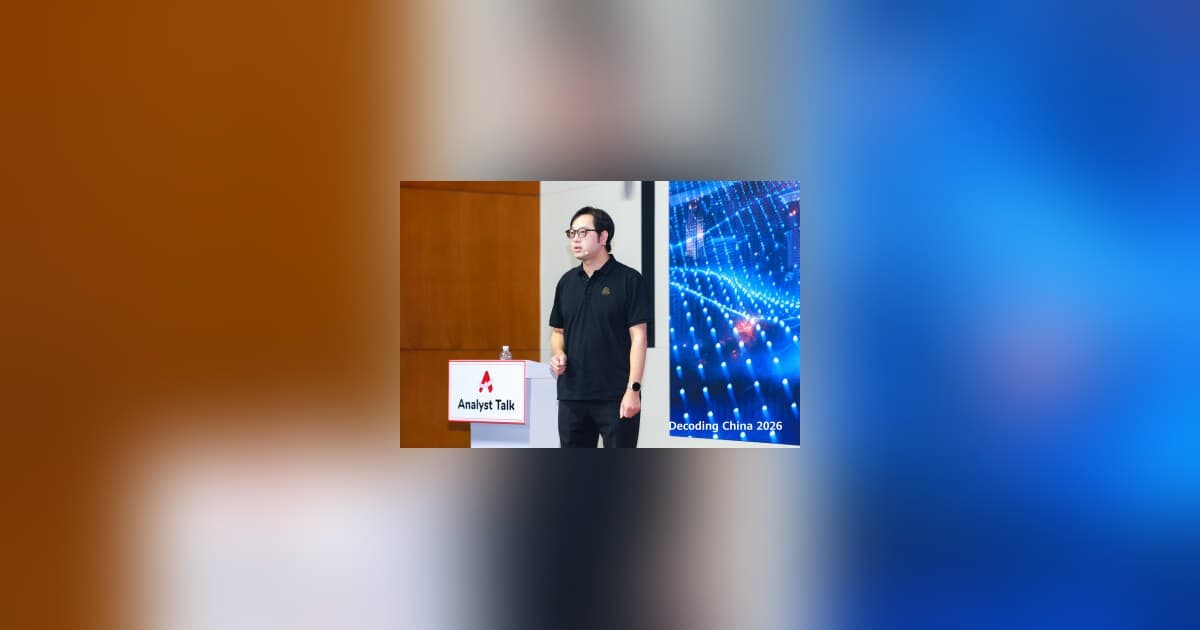
Huawei Wireless has unveiled a series of innovation breakthroughs aimed at pioneering new communications networks, announced by Fang Xiang, Corporate Vice President and President of Wireless Network Solution of Huawei, at Huawei Decoding China 2026. The breakthroughs focus on root technologies spanning ubiquitous experience, simplified and green networks, and superior spectral efficiency, and have produced the world's first commercial U6 GHz device VitaAAU alongside the GigaGreen Plus series and UBBPi series.
The announcements matter to operators and the broader business services sector because mobile networks are being reshaped by booming intelligent devices and services. Huawei notes that new devices are expanding connectivity from people to things and agents, increasing the number of connections by 100 times, while device-cloud synergy for intelligent services demands stronger uplink capabilities. New interaction modes also call for ubiquitous steady ultra-low latency with high reliability, shifting network focus from downlink dominance to both uplink and downlink. As the world enters an intelligent era, Huawei argues the value of connectivity is less about quantity and more about quality.
To address concurrent ultra-high bandwidth and ubiquitous coverage, Huawei introduced RetinaMIMO, which features the industry's first Retina scanning system that allows RF link topologies to be reconstructed to eliminate coverage collapse in the vertical direction, plus a reconstructed antenna array architecture to counter diminishing marginal gains as array elements increase. Based on RetinaMIMO, the world's first commercial U6 GHz device VitaAAU widens coverage by about 30% compared with similar products with 1024 array elements, enabling U6 GHz to match C-band in both horizontal and vertical directions and letting operators deliver U6 GHz coverage on their C-band sites to minimize overall TCO. VitaAAU has seen commercial adoption in the UAE and other markets, with peak downlink speeds exceeding 10 Gbps.
For simplified, green networks, Huawei's EP power amplifier architecture uses new materials and technologies to maximize energy conversion efficiency on higher frequency bands, while the industry's first multimode dielectric filters keep antennas small and low-power on multi-channel high-band networks. The VitaAAU antenna is reduced to 1.5 m in diameter while supporting "0 Bit 0 Watt 0 Loss," and the GigaGreen Plus series achieves significant reductions in dimensions, weight and power consumption.
For spectral efficiency, Huawei applies the time scaling of the Tau law to base stations for the first time through its OSCAR solution, enabling optimal dynamic resource scheduling across all domains. The UBBPi series improves average user experience by 1.3 times while cutting power consumption by approximately 40%. Huawei also reported that its RANSpirit single-domain autonomy solution, based on a telecom foundation model and digital twins, now serves more than 1.2 million cells across 25 networks and assists over 2,000 engineers. The company is promoting A2A-T standards and commercial open-source OpenAN through partnerships, and the announcement was distributed via Media OutReach Newswire. For operators, the implication is a potential path to lower site costs and energy bills while meeting rising uplink and latency demands.
