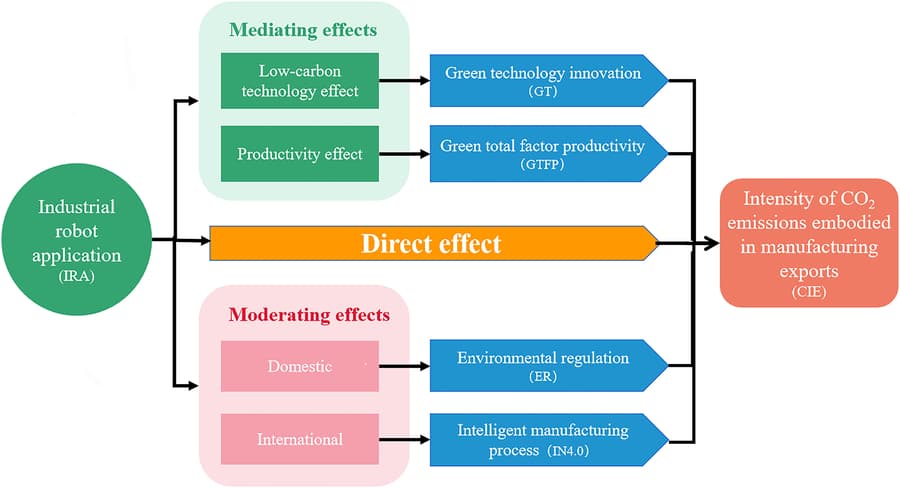
A study published in Data Science and Management has unveiled the pivotal role industrial robots play in diminishing carbon dioxide emissions tied to manufacturing exports. Conducted by researchers from Jiangsu University and Shaoxing University, the analysis spanned panel data from 37 countries over twenty years, offering deep insights into how automation intersects with sustainability and global trade.
The research, accessible via DOI:10.1016/j.dsm.2024.09.003, demonstrates a notable decrease in CO2 emissions embodied in manufacturing exports (CIE) attributable to the use of industrial robots (IRA). This discovery points to robotic automation's potential in reducing the carbon footprint of exported goods, a critical consideration in the fight against climate change amidst growing global trade volumes.
However, the relationship between automation and emissions is complex, revealing a U-shaped pattern where emissions first decline before stabilizing. This 'rebound effect' indicates that while industrial robots can cut emissions in the short term, their enduring impact hinges on their integration into comprehensive manufacturing strategies.
Dr. Xiaoli Wu, the study's lead author, stresses the importance of these findings, noting that the integration of industrial robots into manufacturing is not merely a technological advancement but a vital step toward achieving global sustainability objectives. The study suggests that the most significant emissions reductions occur when automation is paired with stringent environmental policies and smart manufacturing practices.
The effect of industrial robots on emissions varies by sector, with medium-tech industries seeing the most substantial decreases. The research also notes that the efficacy of industrial robots in curbing CO2 emissions depends on progress in low-carbon technologies, productivity enhancements, and the implementation of strong environmental regulations.
These insights are crucial for policymakers and industry leaders, highlighting the necessity for policies that encourage the development and adoption of industrial robots alongside green technological innovations. The study advocates for smart manufacturing practices, including the integration of low-carbon technologies and compliance with strict environmental standards, to fully realize the emission-reduction capabilities of industrial robots.
In the broader context of global climate change mitigation efforts, the study's findings are particularly pertinent. As countries strive to reduce greenhouse gas emissions without sacrificing economic growth, the importance of industrial automation in fostering sustainable manufacturing processes becomes increasingly clear. By harnessing the potential of industrial robots and aligning technological advancements with sustainability goals, the manufacturing sector can play a significant role in decreasing the carbon footprint of international trade.
This research underscores the intricate relationship between technology, policy, and environmental outcomes. While industrial robots present a promising solution for reducing emissions, their maximum effectiveness is achieved when deployed as part of a comprehensive environmental strategy. This highlights the importance of a holistic approach to sustainable manufacturing that marries technological innovation with policy measures aimed at promoting environmental stewardship.
As the volume of global trade continues to rise, the study offers a blueprint for industries and governments to pursue more sustainable production methods. By adopting strategies that leverage the emission-reducing potential of industrial robots, manufacturers can not only lower emissions but also contribute to steering global trade toward a more environmentally friendly future, tackling one of the era's most urgent challenges.