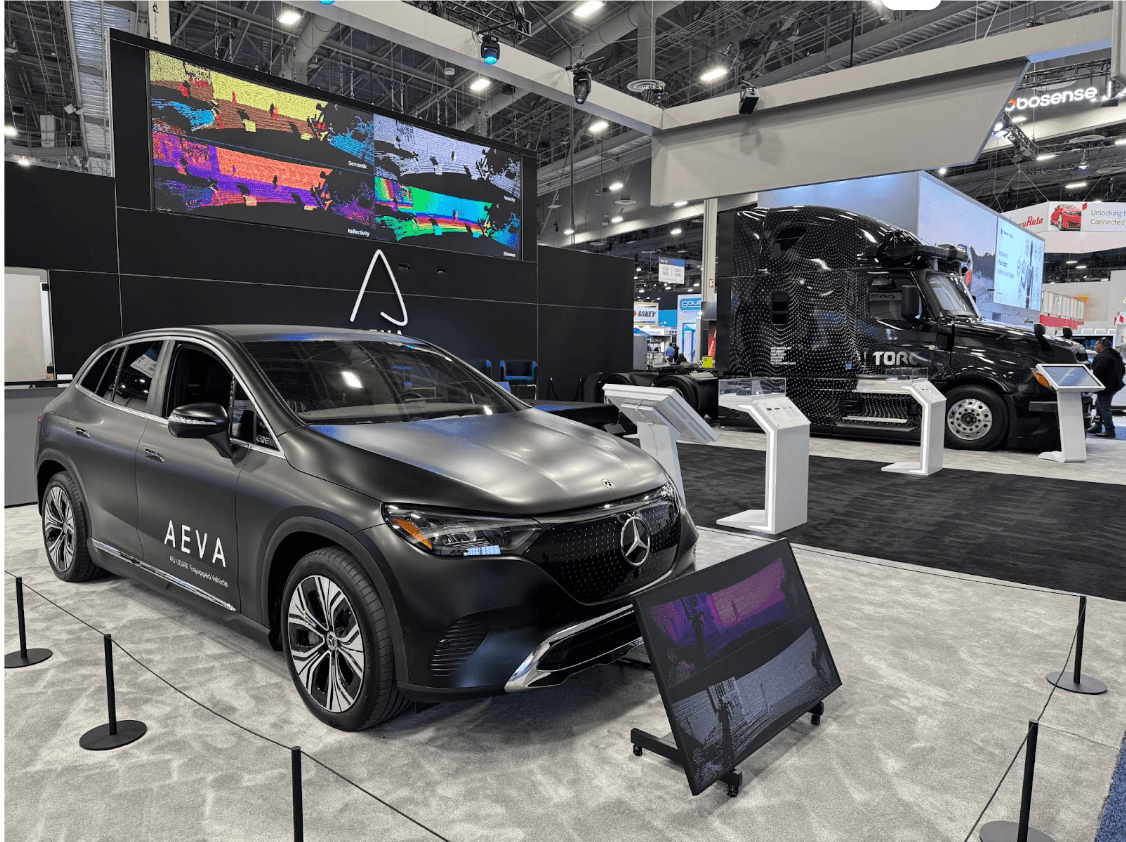
Aeva Technologies has introduced the Atlas Ultra LiDAR sensor, a groundbreaking development in autonomous vehicle technology that significantly enhances perception and sensing capabilities for both passenger and commercial vehicles. The new sensor boasts up to three times the resolution of Aeva's standard Atlas product, with a configurable field of view that extends to 150 degrees across the horizon. This innovation is complemented by on-sensor perception software that enables a maximum detection range of up to 500 meters, a critical advancement for autonomous driving systems.
The Atlas Ultra's design features a 35% slimmer profile, facilitating seamless integration behind vehicle windshields or rooflines without detracting from vehicle aesthetics. This addresses a major challenge in autonomous vehicle development, balancing advanced sensing technology with vehicle design. At CES, Aeva, in collaboration with Wideye, a division of AGC Group, showcased the industry's first functional Frequency Modulated Continuous Wave (FMCW) in-cabin 4D LiDAR solution. This demonstration highlighted the sensor's capability for enhanced long-range sensing with minimal aerodynamic impact, a key factor in autonomous vehicle performance.
Among its advanced features, the Atlas Ultra is immune to direct sunlight and other LiDAR sensor signals, ensuring reliable operation under various conditions. It can detect small objects on the roadway with centimeter accuracy, distinguish between lane markers and road hazards, and track dynamic objects at greater distances than conventional 3D time-of-flight LiDAR sensors. These capabilities represent a significant leap forward in autonomous vehicle safety and efficiency.
Aeva has also strengthened its partnership with Torc Robotics, a subsidiary of Daimler Truck AG, to develop advanced safety architectures for autonomous truck technology. This collaboration leverages 4D LiDAR sensing data and utilizes a Freightliner Cascadia vehicle platform to enhance intelligent decision-making in autonomous vehicles. The company's custom silicon, including the Aeva CoreVision LiDAR-on-Chip module and X1 System-on-Chip processor, plays a pivotal role in enabling sophisticated AI-powered object detection and classification, further advancing the safety and functionality of autonomous vehicles.
With the introduction of the Atlas Ultra sensor and its strategic partnerships, Aeva Technologies is leading the charge in autonomous vehicle technology, offering innovative solutions that promise to make self-driving vehicles safer, more efficient, and seamlessly integrated into the automotive landscape. For more information on Aeva's technologies, visit https://www.aeva.com.